Accountability
Accountability Check-Ins That Don't Fail: A Practical System
Most accountability check-ins fail because they're vague and inconsistent. Use this practical format with proof, fixed cadence, and weekly reviews to actually improve follow-through.
 7 min read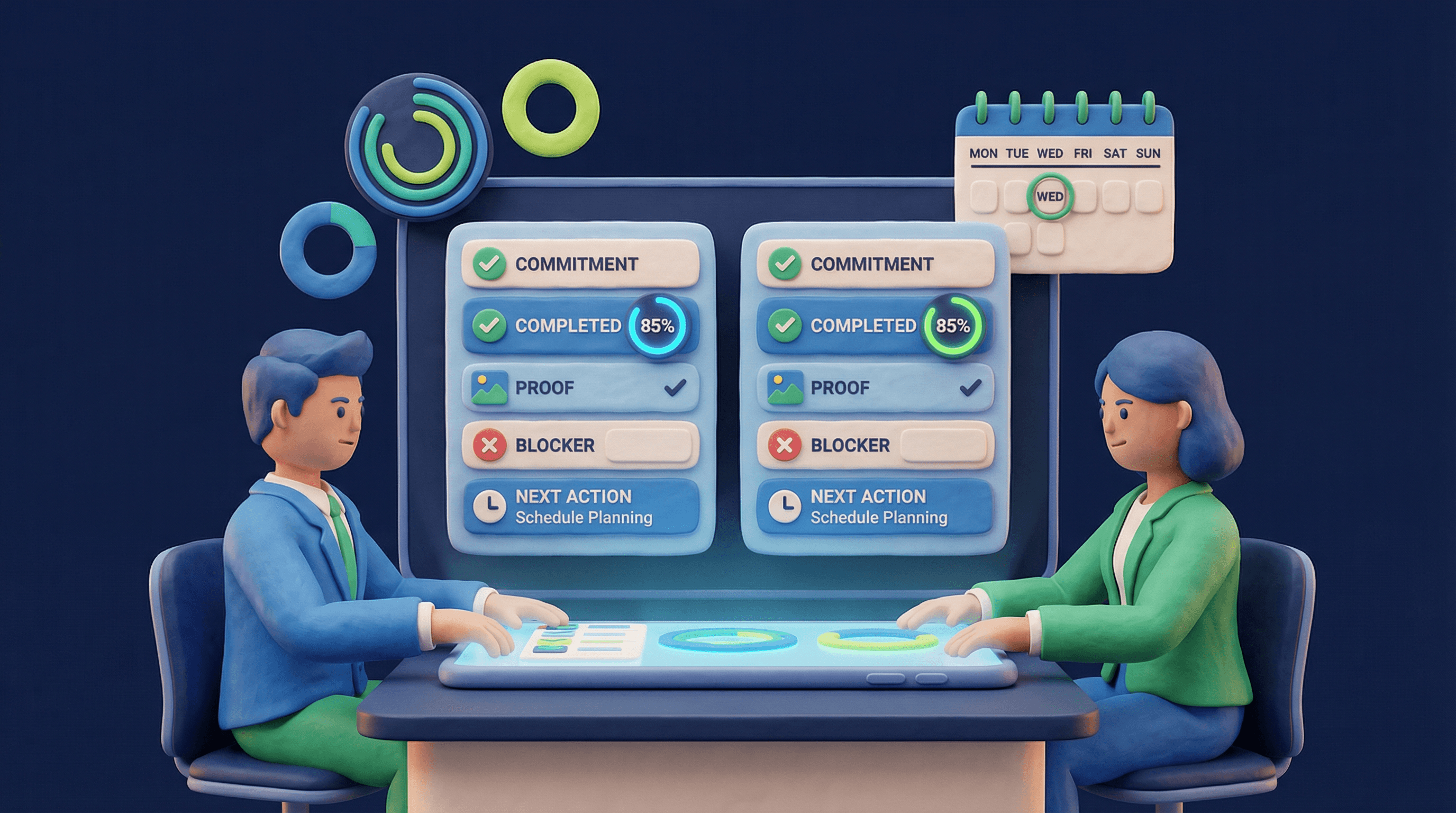
Most people don't fail their goals. They fail their check-ins.
If your updates are random, emotional, or unclear, accountability turns into noise. You say "I'll do better tomorrow," your partner says "you got this," and nothing actually changes. That's not accountability — that's a group chat.
A good check-in system should be short, objective, and repeatable. When check-ins work, everything else in your accountability system works better.
Why Check-Ins Break
Before building the solution, understand why most check-ins fail:
1) No fixed schedule
When check-ins happen "whenever," they stop happening. Life fills the gap, and both partners silently agree to let it slide.
2) No proof requirement
"I worked out today" is easy to type — even when you didn't. Without proof-of-work tracking, check-ins become honor-system reporting that invites self-deception.
3) No next action
Most check-ins look backward: "Here's what I did." Strong check-ins also look forward: "Here's what I'm doing next." Without a next action, there's nothing to hold you to at the following check-in.
4) No review loop
Individual check-ins catch daily execution. But without a weekly review, you miss patterns — like the fact that you've skipped every Thursday for a month.
5) Too much storytelling
Some check-ins become therapy sessions. Long explanations of why you missed, how you feel about it, and what you plan to change "eventually." Empathy is important, but structure prevents drift.
The 5-Line Check-In Format
Use this exact template for every check-in:
- Commitment: What did you commit to doing?
- Completed: What actually got done?
- Proof: Photo, screenshot, or log
- Blocker: What created resistance?
- Next action: What is your next concrete step?
This keeps check-ins focused on execution, not storytelling. Each field has a purpose:
- Commitment creates accountability for what was promised
- Completed forces honest reporting
- Proof removes ambiguity
- Blocker surfaces friction you can fix
- Next action creates the anchor for tomorrow's check-in
Good Check-In vs. Bad Check-In
Bad check-in:
"Didn't really get to my workout today. Was busy with work stuff. Will try harder tomorrow. Feeling kind of unmotivated tbh."
This has no proof, no specific next action, and invites a comfort response instead of a strategic one.
Good check-in:
Commitment: 30-min run after work Completed: 15-min walk instead (busy day) Proof: [step counter screenshot] Blocker: Late meeting ran over, lost energy Next action: Run at 7am tomorrow before meetings start
This is specific, honest, includes proof, identifies the friction, and has a clear plan. A good partner can engage with this meaningfully.
Choosing the Right Cadence
Your check-in frequency should match the difficulty and urgency of your goal:
Daily check-ins
Best for: High-friction goals where resistance is strong — gym, diet, study, daily writing.
Daily cadence catches drift immediately. If you miss, you know within 24 hours. This is the gold standard for building new habits.
3-5x per week
Best for: Moderate goals where daily tracking feels excessive — project milestones, skill practice, content creation.
This gives breathing room while maintaining enough touchpoints to stay accountable.
Weekly check-ins
Best for: Long-term projects where daily progress is hard to measure — business goals, large creative projects, financial targets.
Weekly cadence works when paired with a clear metric. Without something measurable, weekly check-ins easily become vague catch-ups.
Choose one cadence and stick with it for at least 30 days. Changing frequency too often signals that the system isn't the problem — the commitment is.
Synchronous vs. Asynchronous Check-Ins
You don't need to be on a call together for check-ins to work.
Synchronous (same time)
- Quick voice or video calls
- In-person meetups
- Real-time messaging exchange
Pros: Immediate feedback, harder to ignore, builds stronger connection. Cons: Scheduling conflicts, time zone issues.
Asynchronous (different times)
- Post your check-in by a daily deadline
- Partner reviews and responds later
- Written format creates a natural log
Pros: Flexible, scalable, works across time zones, creates a searchable history. Cons: Easier to delay or skip, less personal.
Most successful long-term partnerships use asynchronous check-ins with occasional synchronous reviews. Post proof when you finish your habit. Your partner confirms they saw it. Simple.
Rules for Better Follow-Through
Apply these four rules to your check-in practice:
- Never miss twice — one miss is recovery, two is a pattern
- Minimum action still counts — a 10-minute version is better than a zero
- Proof required for "done" — words are not evidence
- Weekly review is mandatory — individual check-ins don't catch systemic issues
Consistency is a process, not a mood. These rules make the process work.
Weekly Review Questions
Every Sunday (or your preferred review day), both partners answer:
- What did I complete this week?
- Where did I miss?
- Why did I miss? (Root cause, not excuse)
- What friction can I remove for next week?
- What one change will I make?
The weekly review is where check-ins become a learning system. Without it, you repeat the same mistakes and wonder why progress stalls.
How to Handle Missed Check-Ins
Partners will miss check-ins. What matters is the recovery protocol.
If you miss:
- Don't avoid your partner — reach out immediately
- Use the standard check-in format with "missed" as your completed field
- Identify the friction that caused the miss
- Commit to a specific recovery action
If your partner misses:
- Send a brief, non-judgmental follow-up: "Hey, didn't see your check-in today — everything okay?"
- Don't lecture or guilt-trip
- Ask what friction they hit and how you can help
- Reinforce the recovery protocol
The goal is to make missing feel safe to report but uncomfortable to repeat.
Scaling From One Goal to Multiple
Start with one goal and one check-in format. Once that's stable (usually after 30 days), you can add complexity:
- Add a second goal with its own minimum action and proof format
- Keep separate check-in threads for each goal
- Never add a new goal until the current one feels automatic
Resist the urge to track five things at once. Focus compounds. Distraction dilutes.
FAQ
How long should an accountability check-in take?
Under 3 minutes. If your check-in takes longer, you're over-explaining. Use the 5-line format: commitment, completed, proof, blocker, next action. That's all you need.
What if my partner never gives feedback on my check-ins?
Raise it directly. Say: "I'd find it helpful if you acknowledged my check-ins or flagged when I'm drifting." If they still don't engage, you may need to find a better-matched partner.
Should I check in even on rest days?
Yes, briefly. A rest-day check-in might be: "Planned rest day. Prepped meals for tomorrow. Next action: morning workout at 7am." This keeps the cadence alive and prevents rest days from quietly becoming quit days.
What tools work best for check-ins?
Any messaging app works. The format matters more than the platform. WhatsApp, Telegram, iMessage, Slack — pick whatever you and your partner already use. The key is low friction and consistent access.
Final Takeaway
Great accountability is not about pressure. It's about clarity.
If your check-ins are structured, specific, and proof-backed, your progress becomes predictable. The 5-line format removes guesswork. The weekly review catches drift. And the right cadence keeps you honest without burning you out.
That's exactly the kind of system DuoGoals is built to support.
 Share this article
 Twitter
 LinkedIn
 Facebook
 Related Articles